
Pine County Arrest Log Sources
Pine County publishes no searchable official log covering recent days. Only one official source exists online. That is the current Pine County Jail roster PDF. Old Pine County News issues carry the multi-day layer. Its "Pine County Sheriff's Blotter" and jail-roster material covered one issue or one week at a time. Editorial selection, deadlines, and publication schedules set that record apart from a live jail list. A weekly item can outlive a jail stay. Some arrests never make the paper. The blotter can add incident context across a run of days. It cannot settle the full arrest count, a current bond, present location, or a final court outcome.
Read Pine County Blotter Reports
Start with the publisher. Ask who put the item out and which dates it covers. A newspaper blotter, a radio segment, a cached PDF, and a sheriff record each answer a different question about Pine County arrests. Work backward from the historical reference toward the official record, since media accounts work better as leads than as final word on an arrest.
- Check the issue date and reporting span. Publication may follow the incident by several days.
- Separate calls-for-service and incident summaries from actual jail bookings. A police response does not always result in arrest.
- Compare a named booking with the current Pine County Jail roster, while remembering that released people may no longer appear.
- Use 24 Hour Arrests when the question concerns today's roster rather than a multi-day narrative.
- Request the underlying report or historical jail entry from the Sheriff's Records Unit when exact fields are needed.
This habit guards against one common mistake. It keeps you from merging two people who share a similar name. A booking number, an arrest date, the agency involved, and a court case number all identify a person far better than a headline ever will. They beat a map marker every time. Contract policing adds another wrinkle in Pine City, Sandstone, and Hinckley. Read the agency field with care. An arrest in a city area can still end up booked at Pine County Jail. A second agency may lodge a hold on top of that. City, arresting agency, booking agency, and place of confinement are related facts. They are not automatically the same thing.
Pine Arrest Log Entry Fields
The historical newspaper layer mixes brief sheriff activity with roster material. No single field set is guaranteed. Treat any reproduced roster entry as a statement from its booking era. Where a detail is missing, never borrow it from an unrelated third-party profile.
| Possible detail | How to use it |
|---|---|
| Name and date | Starting identifiers that still require comparison with an official record. |
| Call or incident summary | Editorial context that may describe activity without documenting a booking. |
| Arresting agency | The credited agency, not necessarily the owner of each later record. |
| Charge or statute | An charge at that stage, subject to later court changes. |
| Bond or custody text | A time-specific condition that may already have changed. |
| Photo and disposition | No current news-photo cadence was verified; disposition comes from court. |
The Pine County public roster PDF is text based. It displays no booking photographs. Historical newspaper PDFs say nothing about a current mugshot-gallery policy. Minnesota public-data rules may allow a photo request, but that legal right is separate from a publisher's choice about what to display.
Weekly Pine Sheriff Coverage
The Pine County News builds the clearest historical paper trail. Its issue PDFs carried a sheriff's blotter plus jail-roster material. One issue covered January 25 through 31. That is a weekly narrative record. Photo and selection practices can shift with each issue.
WCMP offers a second weekly channel for Pine County arrests. Its Pine County Sheriff segment page lists a Thursday morning slot. It also links to podcasts. The audio can explain recent enforcement activity across several days. Still, it is not a custody database.
The county's own jail and court remain the booking authorities.
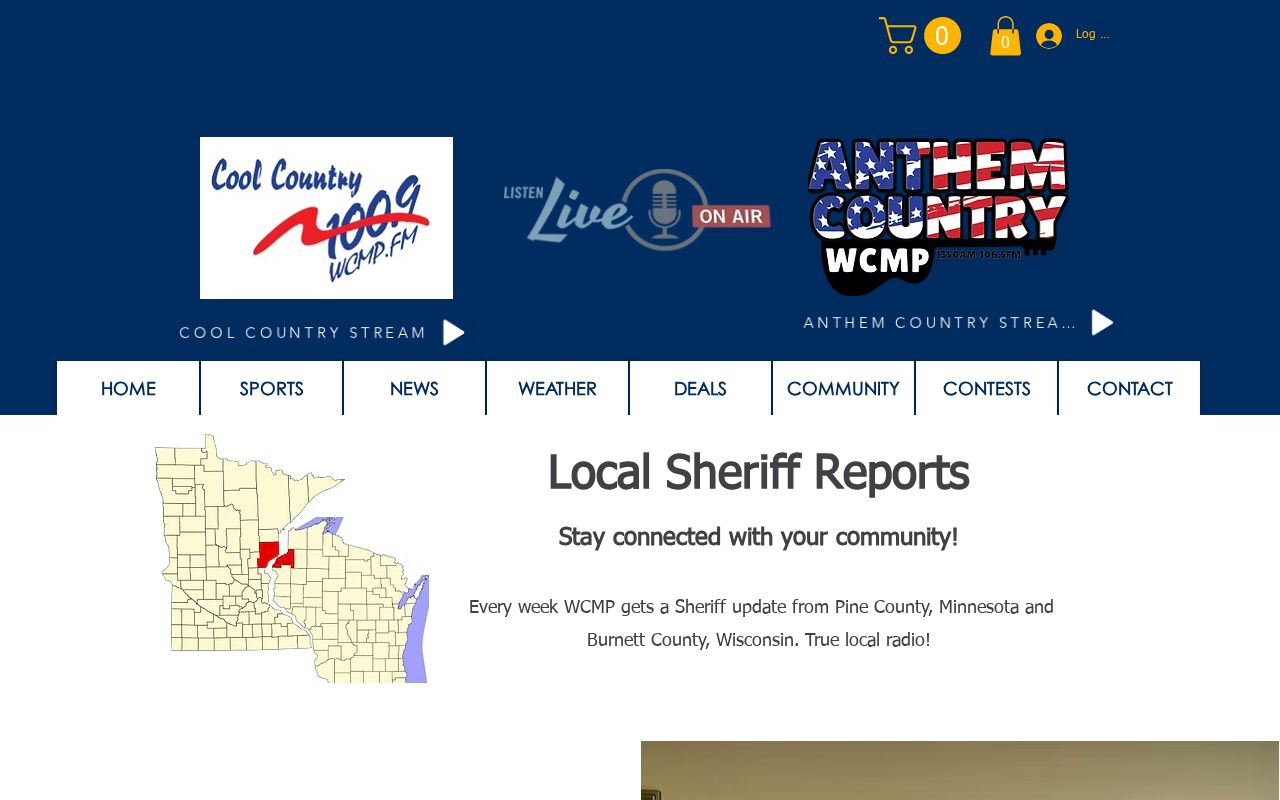
A weekly radio segment adds color that a roster cannot. For who is actually in custody, the jail and court still decide the record.
Pine Arrest Archives and Retention
The live roster gives no date-by-date archive of Pine County arrests. Retention schedules fill part of that gap. Adult jail register books are slated for permanent retention. They can also transfer to State Archives. Each book holds a name, commitment number, admission and discharge dates, offense, sentence length, and discharge type. Admission and release records run on a separate two-year-after-discharge clock. Jailer's daily activity logs are permanent, though some parts stay private or confidential.
Photos are less certain. No schedule line names booking photographs outright. Ask the Pine County Sheriff's Records Unit which series controls a given item. Staff can say whether it sits with the county, moved, was destroyed under schedule, or stays withheld.
- Name and known booking or commitment number
- Date range and arresting agency
- Record type, such as adult jail register or admission/release record
- Inspection or copy preference and desired format
- A retention-series answer if the record is unavailable
If the county confirms a transfer, the Minnesota State Archives is the next official stop. An archived jail entry still shows who was held, and when.
Unofficial Pine Arrest Snapshots
JailRosters.org runs one more option. Its unofficial Pine County archive stores daily-dated cached copies of the county's arrest roster PDFs. The index reaches back several years. That span makes it easier to pin down a date before filing an official records request. Treat the cached pages with care, though. A cache can lag behind Pine County, miss a correction, or preserve an entry the county has already pulled.
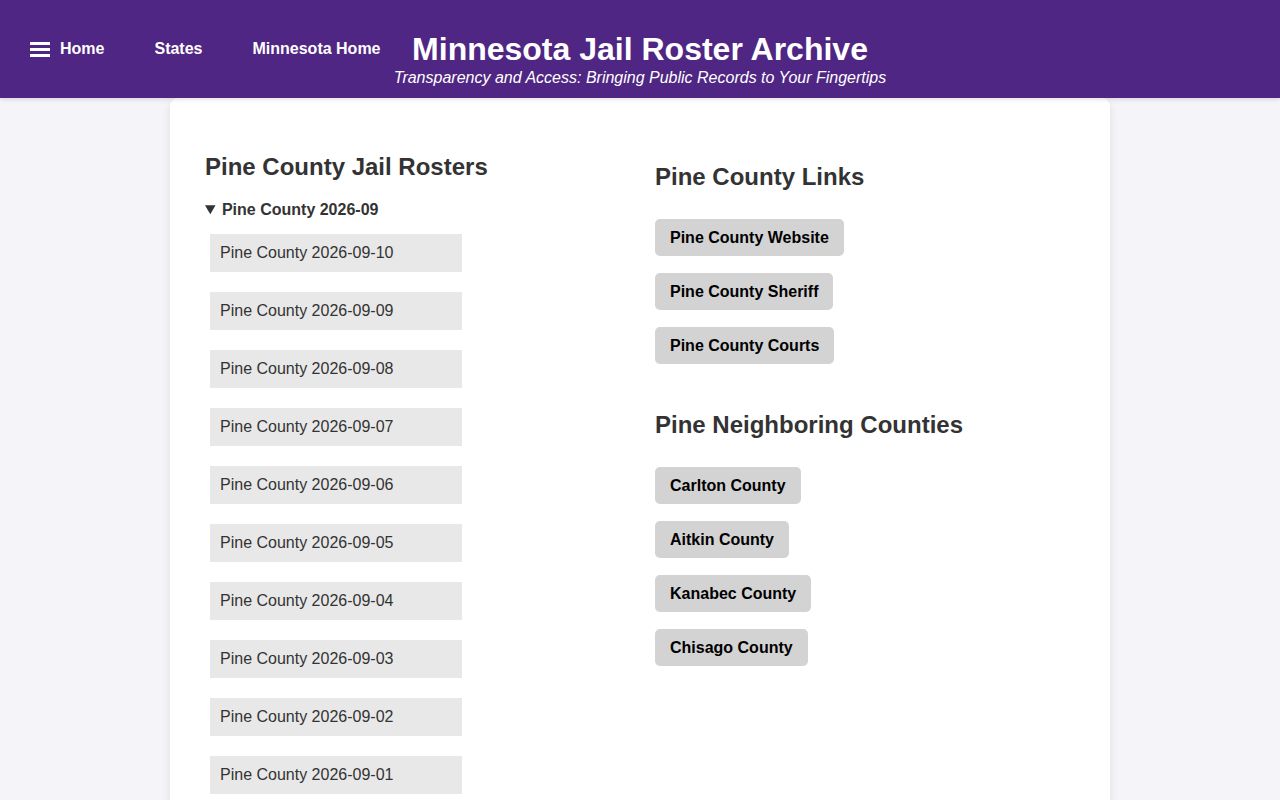
Always check a cached item against Pine County's own records. Custody status and corrected names deserve that extra step. Regional news archives can add helpful context around a date or address you're tracing, and SpotCrime's Pine County archive maps reported activity by day.
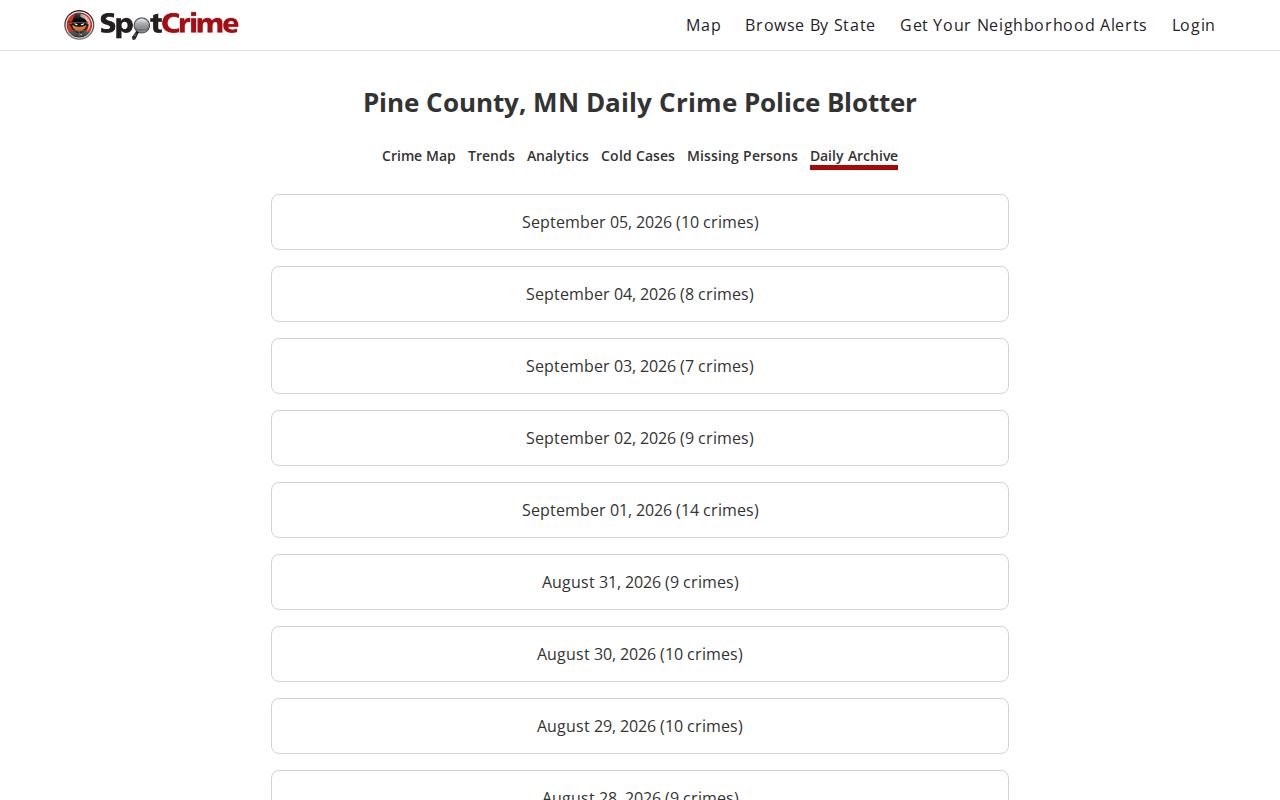
A map pin is only a starting point. It can suggest where and when to search Pine County arrest records, but never who was booked or how a case ended.
From Pine Arrest to Disposition
An arrest log entry is not the whole story. It is the first step in a chain. Booking follows the arrest, a court filing follows the booking, and a disposition closes it out. Each stage lives in a different record system. The log captures what an agency reported. The jail roster shows who is in custody. For later events, Minnesota Court Records Online and Pine County District Court are the places to look. Counts often change along the way, through amendment, reduction, or dismissal.
When quoting an entry, use the source's own wording and the date it lists. That keeps the record honest.
The county-wide Pine County recent arrests page routes to court, booking-photo, records-request, and warrant sources.
Some gaps are structural. MCRO leaves out confidential and non-remotely accessible matters. The Pine court calendar runs on its own business-day cycle. So a missing result does not mean no case exists. Court Administration can explain how to reach a file. For the originating report, sheriff records remain the route.
Retention rules sort jail records into distinct series. Adult jail registers, admission and release records, jailer activity logs, and incident complaint logs each serve a different purpose. Each carries its own retention term too. Naming the right series helps Pine County staff answer questions about redaction, transfer, or scheduled destruction. The legal outcome sits only in the court file.
A good records request names its targets precisely. Include the issue citation, the event date, the booking identifier, and the agency. Ask whether Pine County still holds the record or has transferred it to State Archives. That creates a traceable official path.
Watch the dates. An incident date, an arrest date, a jail admission date, an issue date, and a court filing date can all differ. Record each label exactly as written. A report may also name a call location, a contract-service city, an arresting agency, and the Pine County Jail as separate facts.
Keep requests focused: a printed date range, a booking number, and the exact record sought. If the record is unavailable, ask for the governing retention series and its disposition information. A cached news capture shows an access pattern, nothing more, and it should never be turned into a gallery of people.
Public Record Search
Sponsored Results